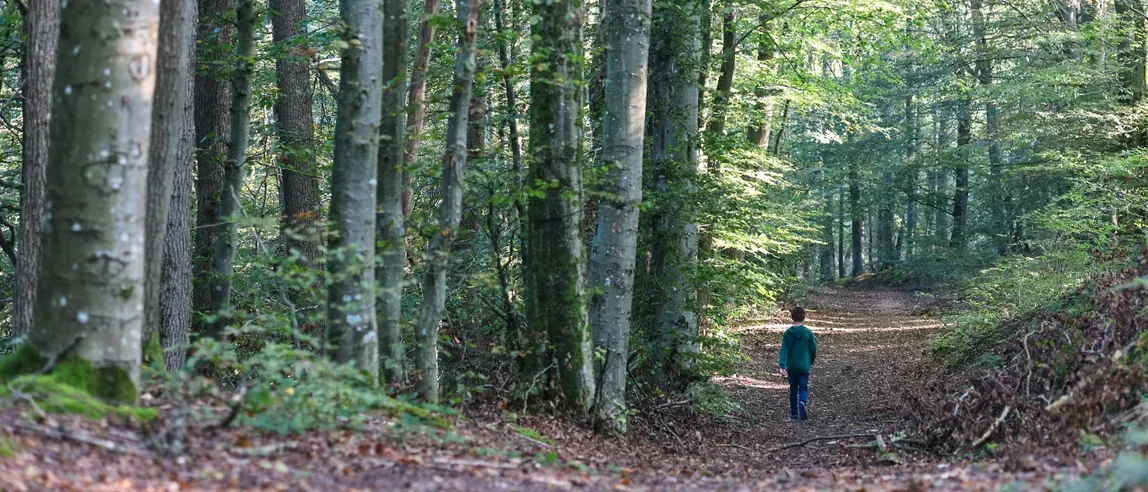
Mushrooms in the forests around Boulac
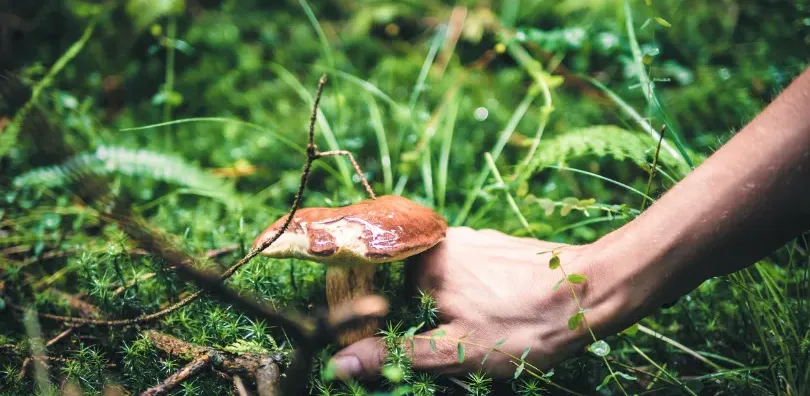
In autumn, the forest floor around Domaine Le Boulac suddenly has all kinds of things to discover. Red caps with white spots appear among the leaves, small fans grow on dead wood, and some mushrooms become almost as big as a breakfast plate. After a spell of rain and mild temperatures, this world slowly emerges, and a walk in the woods turns into something of a treasure hunt.
Why so much grows here
The forests around Izier are mostly beech and oak, often on acidic slate soil, with damp slopes along the Aisne valley that stay cool long after the rain. That's exactly the climate mushrooms love. Towards Ozo, Barvaux and Bomal you'll also find more chalky soils, so you come across quite different habitats within a short distance.
What you see on the forest floor is actually just a small part of the mushroom. Beneath the leaves and inside dead wood lies a vast network of fine threads: the mycelium. Some of these fungi help trees take up water and nutrients, while others break down dead wood and leaves. So mushrooms aren't only colourful autumn sights — they help the forest grow and renew itself.
Species to look out for
Striking, and lovely to photograph:
- Fly agaric: the wellknown red mushroom with white spots, straight out of a fairy tale. Beautiful, but poisonous.
- Parasol mushroom: tall on its stem, with a cap that grows almost as wide as a plate.
- Common stinkhorn: often noticed by smell before you see it; the scent draws in insects that spread its spores.
- Turkey tail: small fans with coloured rings, growing on dead wood.
Some are also familiar from the kitchen:
- Cep (porcini): recognisable by its sturdy stem and brown cap.
- Chanterelle: a yellow-orange mushroom, with ridges rather than gills under the cap.
- Hedgehog mushroom: no gills or ridges, but tiny spines under the cap.
- Horn of plenty: a dark, trumpet-shaped species that barely stands out among the fallen leaves.
These names may sound familiar, but that doesn't make the species easy to identify. Some edible mushrooms closely resemble poisonous ones. The death cap and the destroying angel are among the most dangerous of all: deadly, and deceptively ordinary in appearance. A photo, an app or a short description is therefore never enough to decide whether a wild mushroom can be eaten. Happily, for an autumn walk that isn't necessary: looking, comparing and photographing already offer discoveries enough.
Looking on the domain, foraging beyond it
At Domaine Le Boulac the rule is simple: looking and photographing are fine, picking is not. The forest on the domain is private land, and by leaving everything in place you also preserve the discoveries for the next walker.
Beyond the domain, the rules differ from one forest to the next. In the forests of the Walloon Region, foraging is generally allowed, but under certain conditions. You may gather up to ten litres per person per day, in daylight only and for personal use. During the hunting season the forest is closed and foraging is not allowed. In municipal and private forests you need the owner's permission, and in nature reserves you may take nothing at all. And the most important rule: never eat anything you cannot identify with complete certainty.
Go out with a guide
A walk with a mycologist or nature guide shows just how much goes into identifying a mushroom. It isn't only colour and shape that matter, but also the underside of the cap, the stem, the smell and the trees nearby.
A few places nearby worth keeping an eye on. In Marcourt, near Rendeux, walks are organised in some years with French-speaking and sometimes Dutch-speaking mycologists. Afterwards the species found are examined and sorted together. The Parc Chlorophylle in Dochamps also holds regular mushroom walks led by a mycologist, a short drive from the domain. Dates and availability vary from season to season. So check the organiser's calendar or that of Luxembourg Tourisme in advance, and book in good time. Sturdy shoes and clothes that don't mind a bit of Ardennes mud are usually the main thing. If foraging is allowed during the walk, the organisers will let you know whether to bring a basket and a small knife.
At a glance
- Season: mainly September to November; after a spell of rain and mild temperatures, more mushrooms tend to appear
- Where: beech and oak forests on acidic soil around Izier, more chalky soils towards Ozo, Barvaux and Bomal
- On the domain: look and photograph, don't pick (private land)
- Beyond it: the rules depend on the forest owner — in Walloon Region forests, up to 10 litres per person per day
- Safety: never eat anything you can't identify with certainty; some species are deadly
- In case of possible poisoning: the Belgian Poison Centre is reachable day and night on 070 245 245 (from abroad +32 70 245 245)
If you walk the forest paths around Izier in autumn, you really only need to slow your pace a little. Among the leaves, moss and old trunks hides a surprisingly colourful world. And when you return, the calm of your own cottage among the trees is waiting.