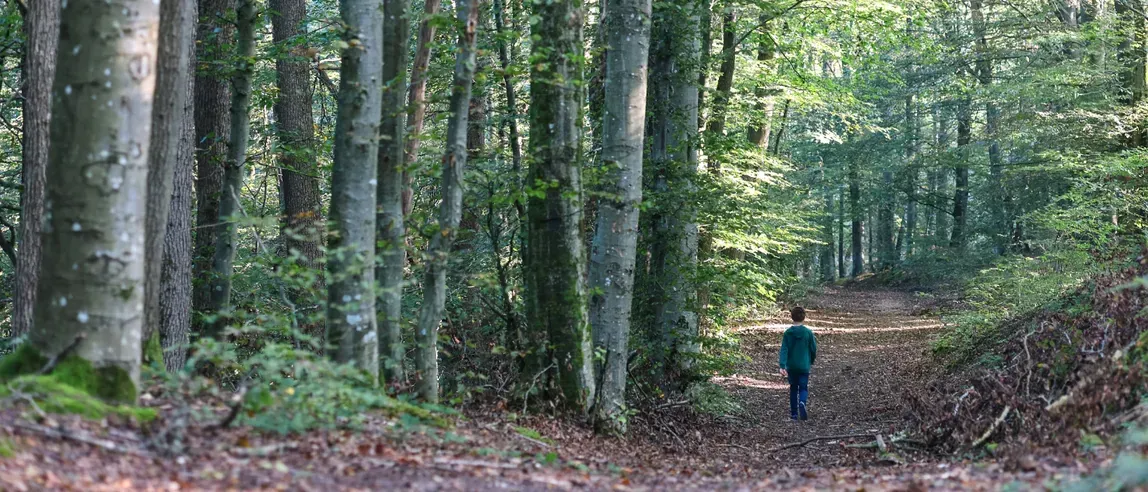


Night in the Aisne Valley – Ardennes near Durbuy

When the Landscape Changes Character
Around Izier (municipality of Durbuy), the valley of the Aisne forms a small-scale stream valley between forest edges and open meadows. During the day, the relief is clearly visible: slopes, field tracks and the course of the stream. After sunset, attention shifts. The landscape remains the same, but the experience changes.
The valley functions as a natural basin. In the evening, cooler air settles into the lower ground. Sound carries further than during the day, human activity decreases, and the distinction between forest and open field becomes less visual and more auditory.
The Valley at Dusk
In a stream valley such as that of the Aisne, the transitions between forest and open terrain are important. These edges remain meaningful in the evening, though for different species. As the light fades, silhouettes become more important than details. Tree crowns outline themselves against the sky. In humid conditions, mist may gather low above the grass. The stream itself remains audible, even when no longer visible.
Species Becoming Active
In wooded parts of Wallonia, the tawny owl (Strix aluco) is a structurally present species. It is closely associated with deciduous woodland and hunts at dusk and during the night. Its call can be clearly heard in quiet conditions, particularly in spring and autumn. Along watercourses and forest edges, various bat species forage. They hunt insects above the stream or along hedgerows. Their presence is rarely visible, yet characteristic of stream valleys with limited disturbance. Larger mammals such as roe deer and fox are also primarily active at dusk. In transition zones between field and forest, they are occasionally observed, usually briefly and at a distance. These are not exceptional occurrences, but elements of normal nocturnal life in an Ardennes valley.
Sound and Space
What changes most in the evening is the balance between silence and sound. During the day, the valley is filled with wind, human activity and birdsong. In the evening, individual sounds linger longer: a call from the forest, flowing water, a movement in the grass. Due to limited light pollution outside village centres, the night sky remains visible in clear weather. Open sections of the valley offer broader views of the stars than densely wooded areas.
Where the Landscape Is Most Noticeable at Night
The transition between forest edge and open field makes the nocturnal character of the valley most apparent. Along the stream and on slightly elevated areas where the valley opens up, the atmosphere visibly shifts between day and evening. No specific route is required. The difference arises naturally as daylight fades and the landscape reveals itself in another way.
Key facts
Area: Aisne valley around Izier (municipality of Durbuy)
Landscape type: stream valley with deciduous woodland, grassland and field tracks
Structurally present nocturnal species: tawny owl, bats, roe deer, fox
Characteristic phenomenon: cooler air settling in the valley and enhanced sound perception
Light pollution: limited outside village centres
When darkness falls, the valley does not change its form, but its rhythm. What is visible during the day becomes audible at night. The landscape remains recognisable, yet acquires another layer, quieter, less pronounced and more defined by sound and space.